Key takeaways
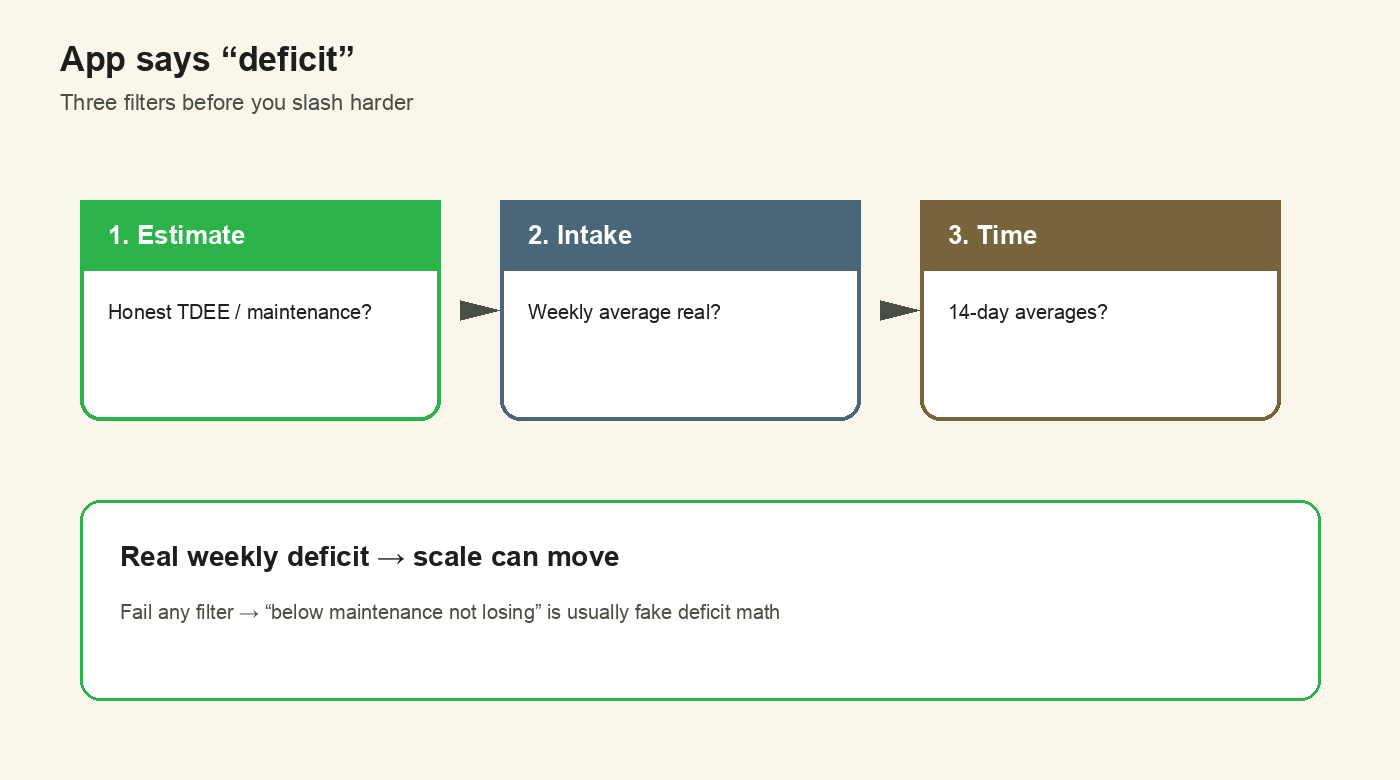
- 1**Eating below maintenance not losing weight** usually means the “maintenance” line is inflated, logging is incomplete, or weekday cuts are erased on weekends — not that calories stopped mattering.
- 2**Eating below TDEE not losing weight** is the same story with a calculator label. Fix activity tier and exercise double-counting before you cut harder.
- 3**Should I eat my TDEE to lose weight?** No. TDEE / maintenance is the *hold-weight* estimate. Fat loss needs a modest deficit from a line you have verified.
- 4Judge progress with **weekly weight averages** for ~14 days. One dramatic morning is water or glycogen noise until proven otherwise.
- 5Change **one** thing: cleaner estimate, cleaner log, or a real sustained deficit — then retest. Recalculate on the [free TDEE calculator](/#calculator) when the week you live changes.
You cut “below maintenance.” The app says you are in a deficit. The scale does not move — or it creeps up. That gap between the plan and the bathroom floor is why people search eating below maintenance not losing weight (and the twin phrase eating below tdee not losing weight). The usual next move is wrong: slash another 300 kcal “just in case.”
Most of the time the problem is not a mysterious metabolism. It is one of three quieter failures: the maintenance (or TDEE) number was high, intake was lower on paper than in real life, or the deficit never survived the full week. This guide walks those checks in order so you change the right lever once — then verify for about two weeks.
Short answer: your “below maintenance” may not be a deficit
If you are eating below maintenance but not losing weight, treat the phrase as a clue, not a diagnosis. On paper you are below a number. In physiology you are only in a fat-loss deficit if:
- 1That number is close to true maintenance for your current body and week, and
- 2Your average intake across seven days is actually below it by a meaningful amount (often ~300–500 kcal/day), and
- 3You have held that pattern long enough for weekly averages to speak (about two weeks), not three quiet weekdays.
When any of those fail, the scale can stay flat while the app still draws a green “deficit” badge. The fix order is always:
Slash-first is how people land on 1,200 kcal with low energy and the same body weight — because the earlier steps were never cleaned up.
When you are ready to rebuild the line, run the TDEE calculator with current weight and an honest activity row — or use the weight-loss TDEE calculator once maintenance feels trustworthy.
Maintenance vs TDEE vs “the number in my notes”
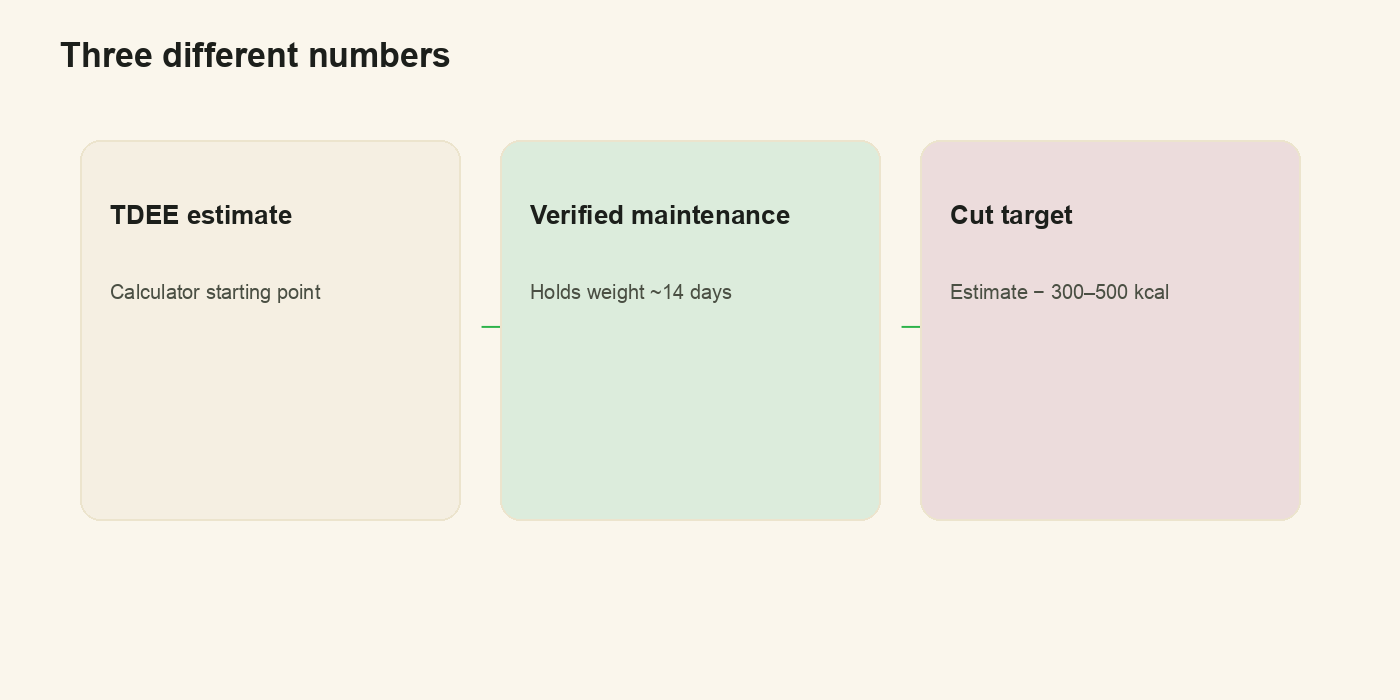
People use maintenance calories and TDEE as everyday synonyms: the intake that tends to hold weight when logging is honest and activity is stable. On TDEEHQ we explain how the day is built under how your body spends calories. A calculator estimate of TDEE is a starting maintenance — not a lab measurement.
[INTERNAL LINK WHEN LIVE: /blog/tdee-vs-maintenance-calories — “Is TDEE the same as maintenance calories?”]
That is why should I eat my TDEE to lose weight? is the wrong target heading. Eating at a good TDEE estimate is how you hold weight. Fat loss needs eating below that line. If someone told you to “eat your TDEE to cut,” they mixed the hold-weight number with the diet number. Use three ways to use your number once the line is clean: cut, maintain, or build.
Your notes might also lag reality. A TDEE from six months and 12 lb (5 kg) ago is not today’s maintenance. A “moderately active” tag from when you walked 9,000 steps at an office is wrong after a remote year at 4,000 steps. Stale notes create the exact search query this article targets.
Check 1 — Is the maintenance estimate honest?
Before you blame hormones or “adaptation,” stress-test the estimate. This is the highest-yield step when eating below tdee not losing weight shows up after a calculator plan.
Activity tier ego
One wrong activity dropdown can inflate TDEE by roughly 200–400 kcal/day. Desk job + two or three real sessions is often lightly active, not “very active.” Use the TDEE activity level chart if you are stuck between sedentary and lightly active. When two levels feel close, start lower, then verify.
Exercise double-counting
If your TDEE already used an activity multiplier, adding full watch calories on top invents surplus food while the app still thinks you are “below TDEE.” Read does TDEE include exercise? and pick Method 1 or Method 2 — never both at full value.
Current weight, not goal weight
Enter the weight you carry today. Goal-weight entries produce a fantasy maintenance for a smaller body, so your “deficit” may already be maintenance for the body you have.
Job and NEAT
Occupational movement dominates many weeks. If you sit most of the day, the desk job TDEE framing helps you stop grading yourself like a physical job. If you are past 40 and notice everyday movement drifting down with the same gym habit, cross-check the age-adjusted calculator after the activity row is honest.
Quick estimate audit
| Red flag | Likely issue | First fix |
|---|---|---|
| “Athlete” / very active + desk job | Tier too high | Drop one tier; chart |
| Lightly active TDEE + full watch add | Double-count | Method 1: no watch add |
| Weight from 6+ months ago | Stale body size | Recalculate at current lb/kg |
| Same kcal as last year, new remote job | NEAT drop | Lower tier or add step floor |
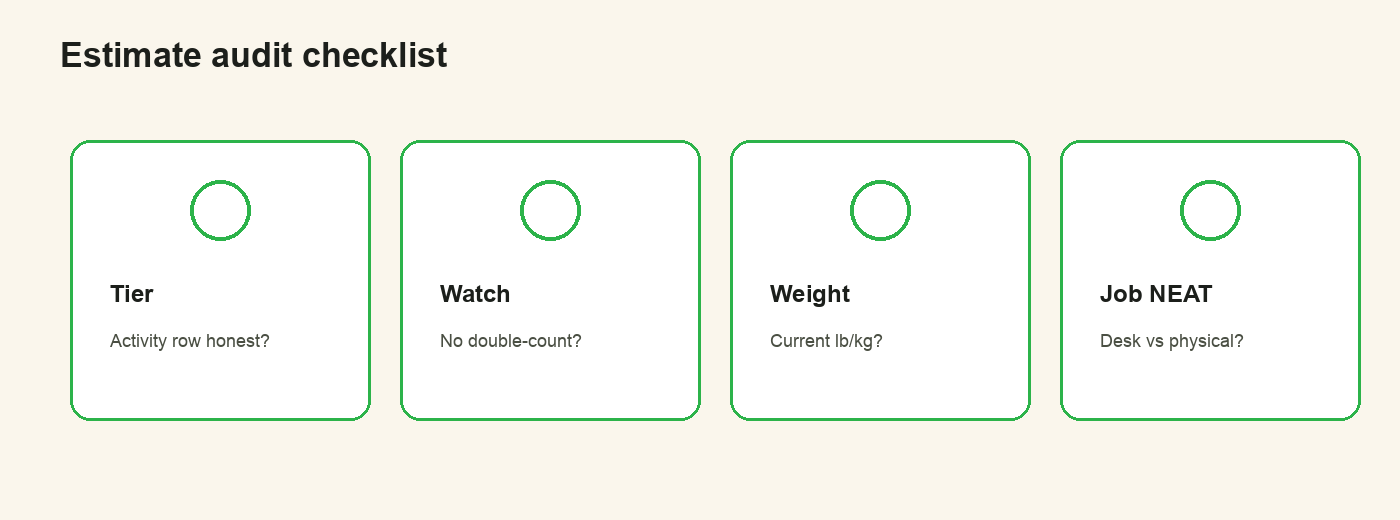
Only after this audit should you trust the sentence “I am eating below maintenance.”
A useful habit: write the activity label and the date next to every TDEE you save. Six months later you will know whether “2,200 kcal maintenance” meant lightly active at 165 lb (75 kg) in winter — or a different life entirely. Without that footnote, people compare today’s intake to a ghost estimate and conclude the universe stopped cooperating.
If you share a kitchen or eat out often, also ask whether someone else’s portions landed on your plate without entering the log. “I barely ate” is a feeling. Weekly averages are evidence. The diagnostic only works when those two are forced to meet.
Check 2 — Is intake what you think it is?
A clean TDEE cannot save a leaky log. When people say they are eating below maintenance not losing weight, weekends and untracked additives are the usual silent partners.
The weekday hero / weekend reset
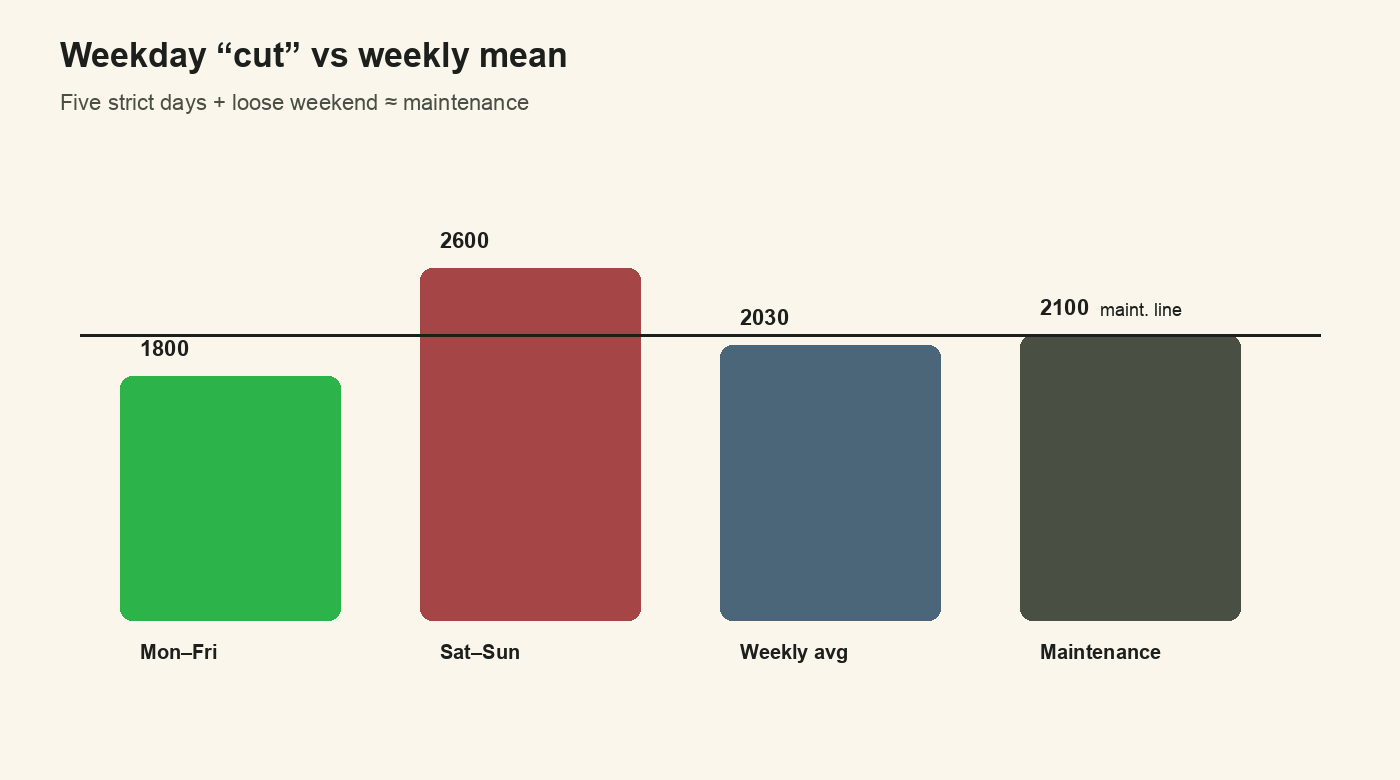
Example structure (illustrative, not your prescription):
| Period | Claimed daily intake | Notes |
|---|---|---|
| Mon–Fri | 1,800 kcal | Tracked carefully |
| Sat–Sun | ~2,600 kcal average | Restaurants, drinks, “off plan” |
| Weekly average | ~2,030 kcal | Looks like a cut on weekdays; near maintenance across 7 days |
If true maintenance is ~2,050–2,100 kcal, the weekly average is not a fat-loss deficit — even though five days “felt” strict. Fat loss cares about the week, not the Monday screenshot.
Classic under-logs
- Cooking oils and butter (easy +100–200 kcal/day)
- Cream in coffee, juice, alcohol
- Bites while cooking, shared desserts, “few” chips
- Protein bar math that ignores the second bar
- Smoothie ingredients weighed as “about a cup”
You do not need perfection. You need a two-week stretch where the big leaks are measured. If weighing food feels extreme forever, do it as a temporary audit, then return to a simpler system that still catches oils and weekends.
Worked weekly picture (lb/kg)
Person: 5 ft 5 in (165 cm), 160 lb (73 kg), desk job, lifts 3×/week.
Calculator TDEE (lightly active, illustrative): ~2,100 kcal.
Plan: 1,700 kcal/day (−400).
| Scenario | True weekly average intake | Likely scale story |
|---|---|---|
| Clean log, weekends included | ~1,700 | Slow loss if estimate is fair |
| Clean weekdays, loose weekends | ~1,950–2,050 | Flat |
| Lightly active + watch add on lift days | Effective surplus on paper | Flat or gain |
Your numbers will differ. The pattern is the point: weekly mean beats daily virtue.
Restaurant math deserves its own warning. Menus rarely match laboratory kcal. A “grilled chicken bowl” can hide oil, sweet sauces, and rice volumes that turn a planned 600 kcal meal into 900–1,100 without looking reckless. You do not need to stop eating out. You need either a buffer on those days, a weighed redo at home the next week to calibrate your guesses, or an acceptance that two restaurant nights require slightly tighter weekdays — still as a planned weekly average, not as punishment.
Travel weeks and holidays follow the same rule. If you already know next week will run high, raise the weekly average on purpose and extend the verification window. Pretending those days “don’t count” is how eating below maintenance not losing weight becomes a three-month mystery.
Check 3 — Time, water, and scale noise
Even a real deficit can look like failure for a week.
- Glycogen and water: Start a cut or a higher-carb training block and the scale can swing 2–5 lb (1–2 kg) without matching fat change.
- Sodium and restaurant meals: Hold water; mornings look “worse.”
- Menstrual cycle: Many women see predictable mid-cycle or luteal bumps. Compare like-to-like weeks when you can.
- Hard training: Inflammation and glycogen refill hide fat loss on the scale for several days.
Rule: Weigh 3–4 mornings per week under similar conditions. Compare week-1 average vs week-2 average in both lb and kg. If averages are flat after two honest weeks and Checks 1–2 are clean, then consider deficit size. If you only have four tracked days, you do not have a metabolism mystery yet — you have missing data.
[INTERNAL LINK WHEN LIVE: /blog/verify-your-tdee-in-14-days — “Verify your TDEE in 14 days”]
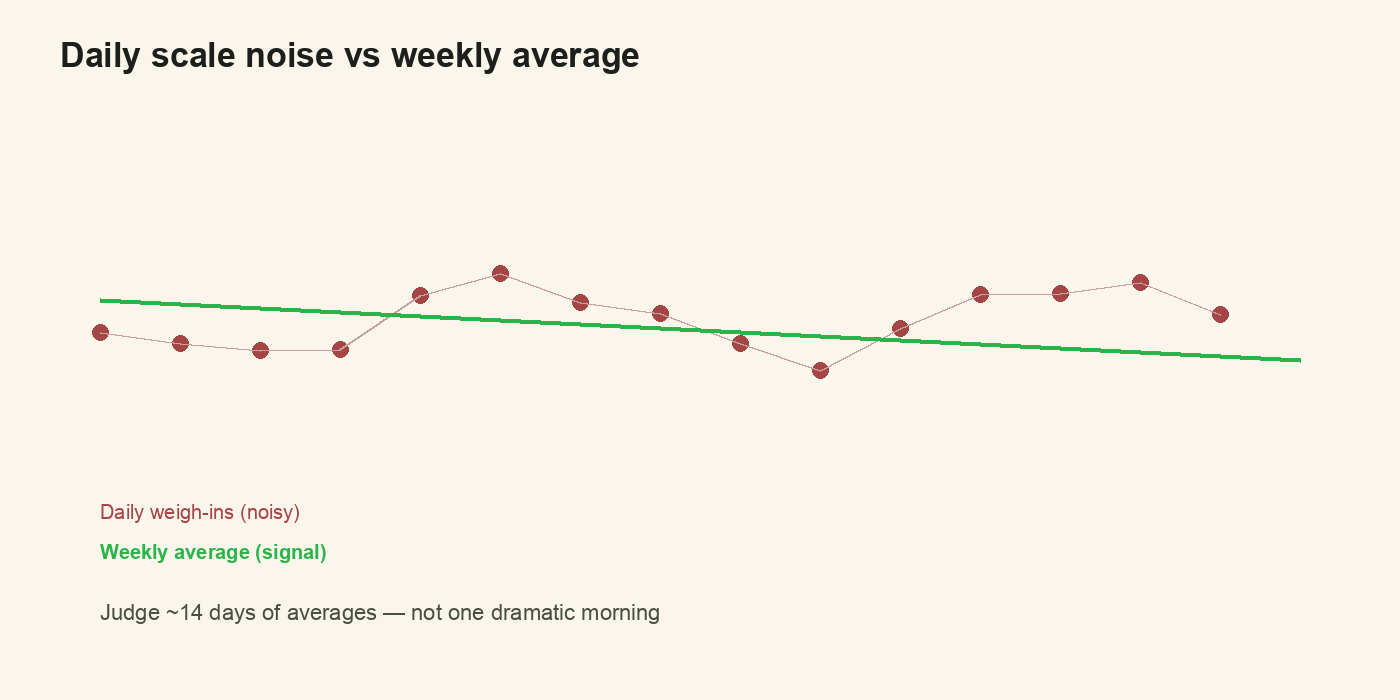
Also separate fat loss from scale loss. You can lose fat while the scale stalls if glycogen is refilling, a new lifting block is adding water to muscle, or sodium is high. Waist measurements, progress photos every 14 days, and how clothes fit are supporting signals — not replacements for averages, but useful when the scale alone feels gaslighty. Conversely, a crashing scale with crushed training and cold fatigue can mean you are under-fueled relative to true needs even if the spreadsheet still shows a “perfect” deficit from a fantasy maintenance.
If sleep crashed for a week, pause the verdict. Short sleep can increase hunger, reduce spontaneous movement, and raise water weight. Fix sleep before you declare the calorie plan broken. That is still energy-balance thinking — just with NEAT and water in the model.
Check 4 — Is the deficit large enough once the line is clean?
After estimate and logging are honest, some people really are only 100–150 kcal below maintenance. That can hold weight for weeks, especially with small NEAT increases you do not notice.
A common adult starting range for fat loss is about 300–500 kcal/day below a verified maintenance line — see goals and the weight-loss TDEE page. Larger cuts look faster and often die on adherence or NEAT.
One-lever menu (pick one)
- 1Drop activity tier one step and recalculate.
- 2Close weekend / oil leaks without changing weekday targets.
- 3Add a step floor (e.g. hold steps within ~1,000 of your usual average).
- 4Nudge intake down 100–200 kcal only after 1–3 failed.
Do not combine all four in the same week. You will not know what worked.
How big should the deficit feel? For many adults aiming for roughly 0.25–0.5% of body weight per week, a moderate cut from a verified line is enough. Example: at 180 lb (82 kg), half a percent is about 0.9 lb (0.4 kg) per week — not five pounds of water after a salty weekend. If your averages move much faster for several weeks, you may be under-estimating expenditure or overshooting the cut; either way, sustainability and muscle retention usually suffer.
Protein belongs in this section only as it ties to the TDEE target: in a deficit, higher protein (often discussed in the 1.6–2.2 g per kg range for lifters) helps preserve lean mass and satiety. It does not create a loophole around a fake maintenance number. Hit protein inside the calorie budget you actually have — after Checks 1–2.
Interactive
Stall diagnostic
Answer in order. Stop at the first “No” — that is usually the lever to fix.
Check 1 of 4
Is your maintenance / TDEE based on current weight and an honest activity tier (no full watch add on top)?
“Eating at maintenance and gaining” — the mirror problem
Searchers also type eating at maintenance and gaining weight. It is the same diagnostic upside-down: the “maintenance” number is low relative to true burn or intake is higher than logged or NEAT fell while calories stayed put.
- If weight trends up for two weeks at “maintenance,” raise the estimate (or admit under-logging) — do not assume the scale is lying forever.
- Recalculate with the maintenance TDEE calculator after you fix the activity story.
- Then, if fat loss is still the goal, set a cut from the new line — not from the old sticky note.
[INTERNAL LINK WHEN LIVE: /blog/not-losing-weight-eating-at-tdee — “Not losing weight eating at TDEE”]
14-day fix protocol
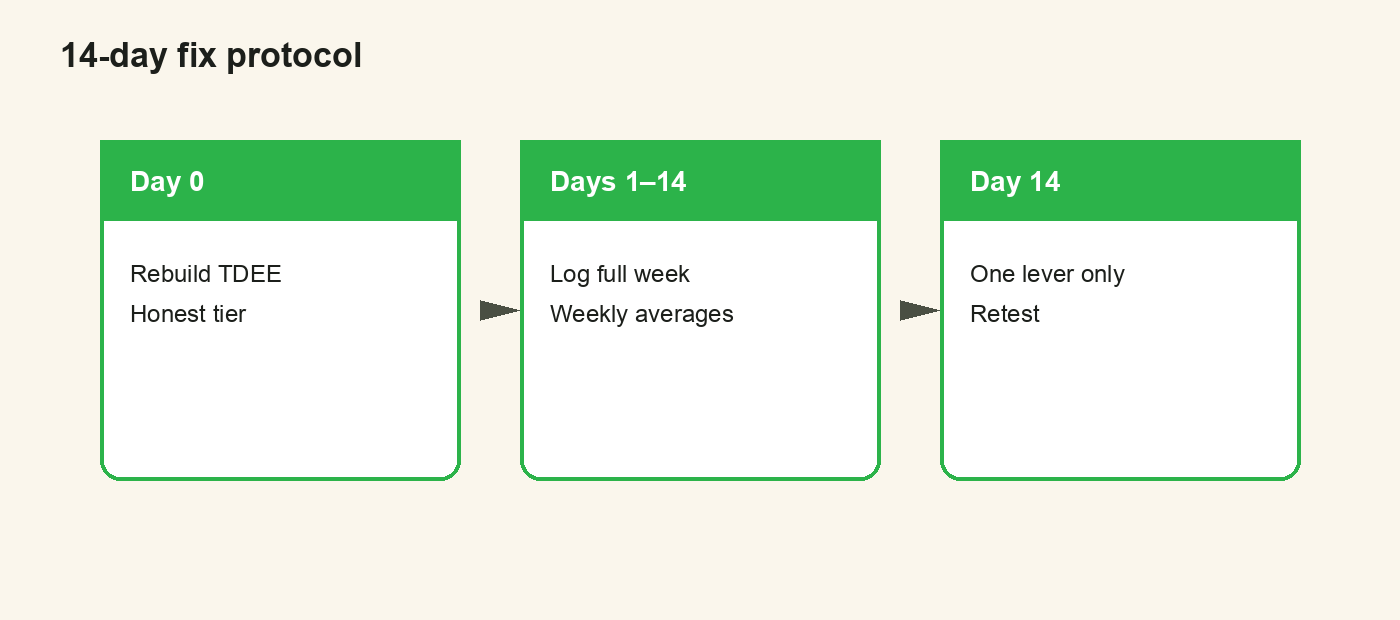
Day 0 — Rebuild the line Open the TDEE calculator. Current weight. Honest activity (use the activity level chart). Confirm you are not double-counting exercise (guide). Write down: estimated maintenance, planned intake, and which single lever you will watch.
Days 1–14 — Hold and measure Log the full week including weekends. Weigh regularly. Compute weekly averages. Keep steps roughly steady so NEAT does not secretly rise or crash.
Day 14 — Read the trend
| Weekly average weight | Likely story | Next move |
|---|---|---|
| Down ~0.25–0.5% of body weight / week | Deficit working | Hold; recalculate after ~5–10 lb (2–5 kg) lost |
| Flat | Estimate high, log leak, or deficit tiny | One lever from the menu above |
| Up | Surplus in disguise | Audit weekends + watch adds; raise estimated maintenance or cut leaks |
Adults over 40 who did everything “right” with an old calculator may need the over-40 adjustment after this protocol — not before Checks 1–2.
Optional mid-protocol note: if day 7 already shows a clear weekly average rise despite a claimed large deficit, do not wait until day 14 out of stubbornness — jump back to Check 2 (weekends, oils, drinks) the same day. The 14-day window is for noise. It is not a reason to ignore an obvious logging hole.
What about metabolic adaptation?
Long diets can lower total daily energy expenditure through smaller body size, lower NEAT, and other adaptations. That is real — and it still does not mean “calories stopped counting.” It means the maintenance line moved down while your sticky-note target stayed put. After months of aggressive cutting, a short return toward estimated maintenance (a diet break) can restore adherence and make the next deficit honest again. Recalculate after meaningful weight loss; do not run year-old math on a smaller body.
[INTERNAL LINK WHEN LIVE: metabolic adaptation cluster post — why TDEE drops on a diet]
If you have only been “dieting” for ten days, adaptation is the least likely explanation on the list. Start with tier, watch double-counting, and weekends.
Mistakes that keep you stuck
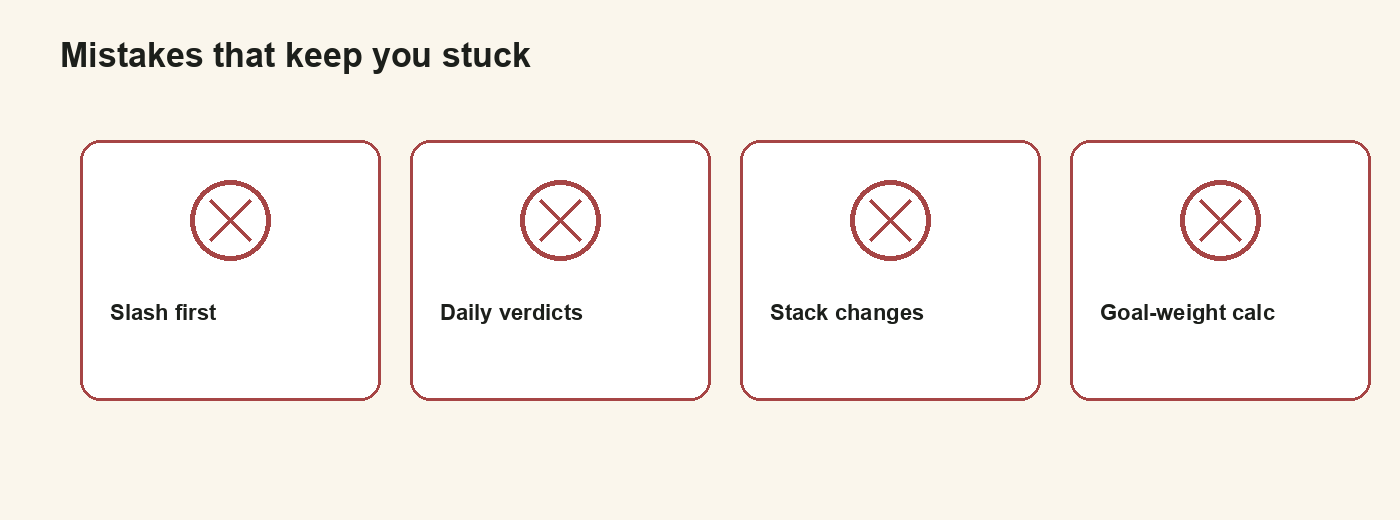
- 1Slash first. Creates fatigue without teaching you which input was wrong.
- 2Daily scale verdicts. Guarantees panic and random diet changes.
- 3New workout + deeper cut the same week. Two variables; zero learning.
- 4Goal-weight calculator entries. Fantasy maintenance.
- 5Ignoring the job. Gym hours do not erase a sedentary occupation in the dropdown.
- 6Forever “diet foods” that are still calories. Volume eating helps hunger; it does not repeal math.
Recalculate with a line you can trust
Eating below maintenance not losing weight is almost never solved by a harsher PDF. It is solved by an honest TDEE, an honest week of intake, and enough days for averages to speak — then a deficit that exists on all seven days, not just the ones you screenshot.
Open the free TDEE calculator, pick a realistic activity row, and write your maintenance and cut targets down. If fat loss is the goal, continue on the weight-loss TDEE guide. If you only need to re-find the hold-weight number, use the maintenance calculator. Change one lever. Retest two weeks. That is how the scale and the spreadsheet start telling the same story.
Frequently asked questions
Because the maintenance number may be high, average intake may be higher than you think, or you have not held a true weekly deficit long enough for fat loss to show under water-weight noise. Run Checks 1–3 before cutting harder.
TDEE cluster

Written by
TDEEHQ Editorial
Nutrition & metabolism writersBSc Exercise Science · Certified Sports Nutrition Coach
TDEE, BMR, NEAT, maintenance calories, and honest activity multipliers
Riley leads TDEEHQ’s guides on total daily energy expenditure — translating Mifflin-St Jeor, activity multipliers, and NEAT research into decision tools people can actually use. Focus: picking the right activity level, avoiding double-counted exercise calories, and verifying estimates with weekly weight averages.
Expertise
- TDEE & maintenance calories
- Activity level multipliers
- BMR formulas (Mifflin-St Jeor, Katch-McArdle)
- NEAT & everyday movement
- Deficit sizing from TDEE
- Exercise calorie double-counting