
Key takeaways
- 1Maintenance calories for 150 lb woman are not a single universal number — height, age, and activity move the result.
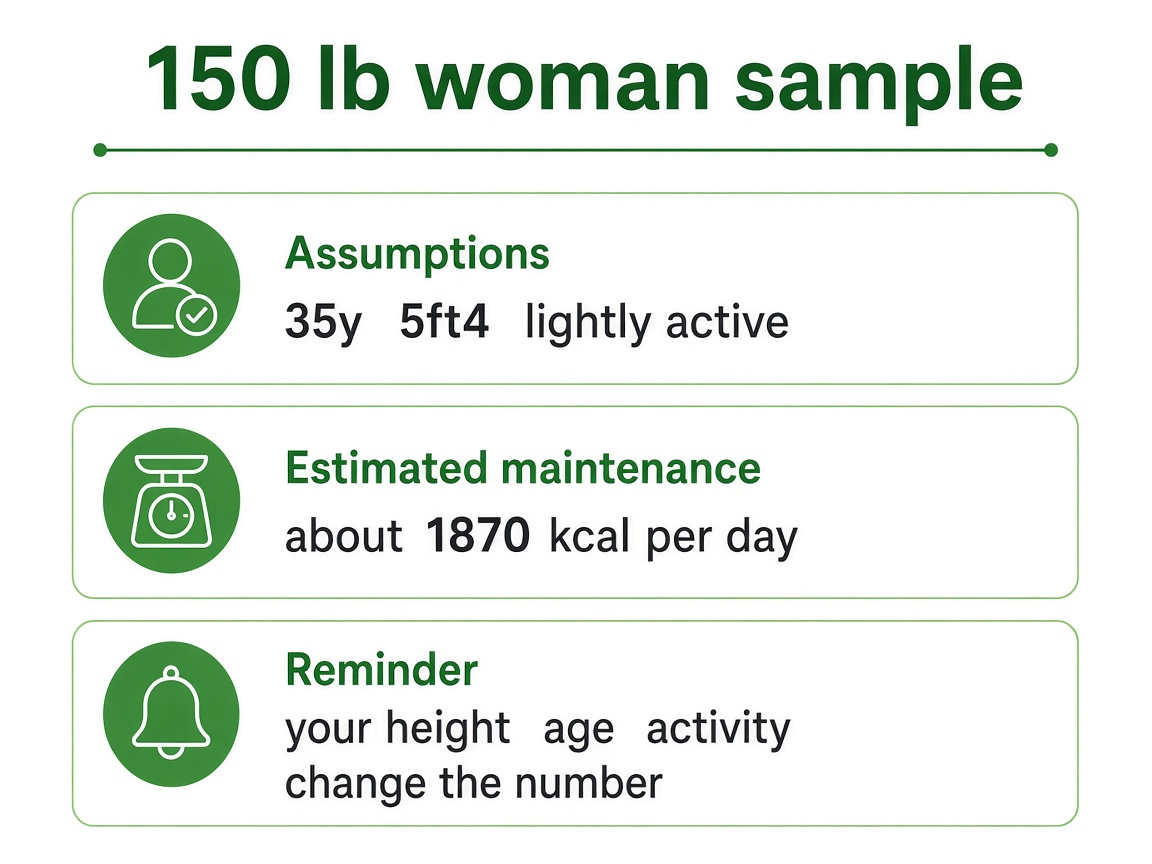
- 2Sample (35 years, 5′4″ / 163 cm, lightly active): about 1,870 kcal/day for a 150 lb (68 kg) woman.
- 3Sample maintenance calories for 170 lb man (35 years, 5′10″ / 178 cm, lightly active): about 2,360 kcal/day.
- 4Tables below are worked Mifflin-St Jeor × activity examples — not lab measurements and not your prescription.
- 5Recalculate with your inputs; verify with weekly weight averages for about 14 days before big cuts.
Search “maintenance calories for 150 lb woman” and you will find charts that spit out one number for weight alone. That is incomplete. Two people at 150 lb (68 kg) can differ by hundreds of kcal once height, age, and activity change.
This page does it the honest way: one calculator-led guide with many worked examples — including the 150 lb woman and 170 lb man queries people actually type — each under stated assumptions. Use a row as a ballpark, then run the free TDEE calculator with your age, height, weight, and activity. On tools like TDEEHQ, that TDEE estimate is your practical maintenance calories line.
Short answer: weight alone is not enough
If you only remember one line: maintenance ≈ estimated TDEE on a BMR × activity calculator — and TDEE needs more than body weight.
For the popular query maintenance calories for 150 lb woman, a transparent sample under the assumptions above lands near 1,870 kcal/day when lightly active. Change the activity tier to sedentary and the same body can drop toward ~1,640 kcal/day. That gap is why random “150 lb = X calories” graphics fail.
Ready for your number instead of a chart row? Open the TDEE calculator (women defaults: TDEE for women).
Why weight-only maintenance charts mislead
How TDEE is built on free tools:
- 1BMR from Mifflin-St Jeor (or Katch-McArdle with body fat) using sex, age, height, weight
- 2Activity multiplier for the whole week — not your hardest gym day (activity level chart)
- 3Result = estimated maintenance for planning
Weight enters step 1. Height and age also enter step 1. Activity dominates step 2. Skip any of those and a “maintenance calories for 150 lb woman” answer is cosplay.
How these examples were calculated
Every table row on this page uses:
- Equation: Mifflin-St Jeor (female −161 constant; male +5)
- Default sample age: 35
- Default sample heights: women 5′4″ (163 cm); men 5′10″ (178 cm)
- Default sample activity: lightly active (×1.375) unless a comparison table says otherwise
- Rounding: nearest kcal, same spirit as the on-site results panel
Sedentary = ×1.2. Moderately active = ×1.55. These are the same public multipliers many calculators share — they are still estimates. Typical adult error is often discussed around ±10%; confirm with the scale before you treat a sticky note as truth.
Do not add a full watch burn on top of a full activity multiplier — that double-counts training. See does TDEE include exercise?.
Height and age move the same weight
Two adults can share a scale reading and still need different maintenance calories.
Height. At a fixed weight, a taller person usually has a higher Mifflin BMR (more lean mass on average in the equation). A 150 lb (68 kg) woman at 5′8″ (173 cm) will not land on the same BMR as the 5′4″ (163 cm) sample in the tables below.
Age. Mifflin subtracts a small amount for each year. A 25-year-old and a 45-year-old at the same sex, height, and weight are not interchangeable — the older estimate sits lower before activity is applied.
Sex constant. Female and male Mifflin constants differ (−161 vs +5). That is why a “maintenance calories for 150 lb woman” chart should never be reused as a male answer, and why this page keeps women’s and men’s tables separate.
NEAT (non-exercise activity). Steps, standing, fidgeting, and job movement sit inside the activity multiplier on tools like TDEEHQ. If your desk day is long but you walk a lot, “lightly active” may fit better than “sedentary.” If you train hard three days a week and sit the rest, do not pick “very active” by ego — read the activity level chart.
Women’s maintenance examples (lb and kg)
Assumptions for this table: female, 35 years, 5′4″ (163 cm), lightly active (×1.375). Swap height or age and your result moves.
| Body weight | kg | Est. BMR | Est. maintenance (light) |
|---|---|---|---|
| 120 lb | 54.4 kg | 1,227 | 1,687 kcal/day |
| 130 lb | 59.0 kg | 1,272 | 1,750 kcal/day |
| 140 lb | 63.5 kg | 1,318 | 1,812 kcal/day |
| 150 lb | 68.0 kg | 1,363 | 1,874 kcal/day |
| 170 lb | 77.1 kg | 1,454 | 1,999 kcal/day |
That 1,874 kcal/day row is the transparent answer to maintenance calories for 150 lb woman under these assumptions — not a guarantee for every 150 lb adult.
Same idea in kilograms
Still female, 35 years, but 165 cm height, lightly active:
| Weight | Est. maintenance (light) |
|---|---|
| 55 kg | ~1,710 kcal/day |
| 60 kg | ~1,780 kcal/day |
| 65 kg | ~1,850 kcal/day |
| 70 kg | ~1,920 kcal/day |
Personalize: free TDEE calculator → women’s page if you want female pre-selected.
Men’s maintenance examples (lb and kg)
Assumptions: male, 35 years, 5′10″ (178 cm), lightly active (×1.375).
| Body weight | kg | Est. BMR | Est. maintenance (light) |
|---|---|---|---|
| 150 lb | 68.0 kg | 1,623 | 2,231 kcal/day |
| 170 lb | 77.1 kg | 1,714 | 2,356 kcal/day |
| 180 lb | 81.6 kg | 1,759 | 2,419 kcal/day |
| 200 lb | 90.7 kg | 1,850 | 2,543 kcal/day |
So maintenance calories for 170 lb man, with these inputs, is about 2,360 kcal/day when lightly active — again a sample, not a clinic report.
Men’s examples in kilograms
Same male defaults (35 years, 178 cm, lightly active):
| Weight | Est. maintenance (light) |
|---|---|
| 70 kg | ~2,280 kcal/day |
| 77 kg (~170 lb) | ~2,360 kcal/day |
| 85 kg | ~2,470 kcal/day |
| 90 kg | ~2,540 kcal/day |
Men’s shortcut: TDEE calculator for men.
Same weight, different activity (where charts blow up)
Hold the 150 lb woman sample body (35y, 163 cm) and only change the multiplier:
| Activity tier | Factor | Est. maintenance |
|---|---|---|
| Sedentary | ×1.2 | ~1,636 kcal/day |
| Lightly active | ×1.375 | ~1,874 kcal/day |
| Moderately active | ×1.55 | ~2,113 kcal/day |
Hold the 170 lb man sample (35y, 178 cm):
| Activity tier | Factor | Est. maintenance |
|---|---|---|
| Sedentary | ×1.2 | ~2,056 kcal/day |
| Lightly active | ×1.375 | ~2,356 kcal/day |
| Moderately active | ×1.55 | ~2,656 kcal/day |
One wrong dropdown is often a 200–400+ kcal miss — larger than many people’s entire planned deficit. Pick the tier with the activity level chart, not your ego.
How to turn a table row into your number
Treat every kcal figure on this page as a starting sample, then personalize in four minutes:
- 1Open the free TDEE calculator.
- 2Enter your sex, age, height (in or cm), and weight (lb or kg).
- 3Choose the activity tier that matches a typical week — not your hardest training day.
- 4Read the TDEE result as estimated maintenance. Write it down.
- 5Decide hold, cut, or surplus on purpose (goals). Do not invent a second “secret” maintenance from a random chart.
If your watch reports workout burn, pick one method: either keep the weekly multiplier and ignore most watch totals, or use a lower multiplier and add a conservative fraction of logged exercise — never both at full strength. Details: does TDEE include exercise?.
Common mistakes with weight-based charts
- Using weight alone. Ignoring height, age, and activity is how “maintenance calories for 150 lb woman” memes disagree by 400+ kcal.
- Copying a man’s number for a woman (or the reverse). Sex constant matters in Mifflin-St Jeor.
- Picking “very active” because you want a bigger budget. Inflated maintenance → “mysterious” fat gain when logging is honest.
- Cutting 1,000 kcal from an unverified line. Start from a believable TDEE, then a modest deficit.
- Changing the plan every three days. Scale noise is normal; use weekly averages for about 14 days before rewriting intake.
- Double-counting exercise. Multiplier + full watch burn stacks the same training twice.
Verify the estimate before you slash harder
A calculator cannot see your NEAT, sleep, or weekend eating. After you have a personal TDEE:
- 1Eat near that line for about two weeks while logging consistently.
- 2Track weekly average weight, not single mornings.
- 3If weight holds (± about 0.5–1% over those weeks for many adults), the estimate is close enough to plan from.
- 4If weight rises steadily, your true maintenance is likely lower (or logging is incomplete). If weight falls, true maintenance may be higher — or you are already in a deficit.
Only after that check should you size a cut. If paper says you are already below maintenance and the scale will not move, audit activity and logging first: eating below maintenance not losing weight.
From maintenance to a cut or a surplus
On TDEEHQ-style math, calculator TDEE is estimated maintenance (full explainer). Then:
| Goal | Practical starting rule |
|---|---|
| Hold | Eat near the verified line — maintenance TDEE page |
| Lose fat | Modest deficit from that line (often ~300–500 kcal/day for many adults) — weight-loss TDEE and goals |
| Gain | Small surplus above the same line; raise slowly if weight jumps fast |
If you are “eating below maintenance” on paper and the scale will not move, fix activity honesty and logging before another slash — eating below maintenance not losing weight.
Next step
- 1Find the row closest to your weight — treat it as a sample, not a sentence.
- 2Pick an honest activity tier (activity level chart).
- 3Run the free TDEE calculator with your real age, height, and weight (lb/kg, in/cm).
- 4Write “maintenance” next to that number, then decide hold, cut, or surplus on purpose.
Use a table row as a sample — then recalculate with your age, height, and activity.
Calculate my maintenanceFrequently asked questions
Under the sample assumptions on this page (35 years, 5′4″ / 163 cm, lightly active), about 1,870 kcal/day. Your height, age, or activity can move that a lot — recalculate personally.
TDEE cluster

Written by
TDEEHQ Editorial
Nutrition & metabolism writersBSc Exercise Science · Certified Sports Nutrition Coach
TDEE, BMR, NEAT, maintenance calories, and honest activity multipliers
Riley leads TDEEHQ’s guides on total daily energy expenditure — translating Mifflin-St Jeor, activity multipliers, and NEAT research into decision tools people can actually use. Focus: picking the right activity level, avoiding double-counted exercise calories, and verifying estimates with weekly weight averages.
Expertise
- TDEE & maintenance calories
- Activity level multipliers
- BMR formulas (Mifflin-St Jeor, Katch-McArdle)
- NEAT & everyday movement
- Deficit sizing from TDEE
- Exercise calorie double-counting