Key takeaways
- 1BMR is the energy your body needs just to stay alive at rest.
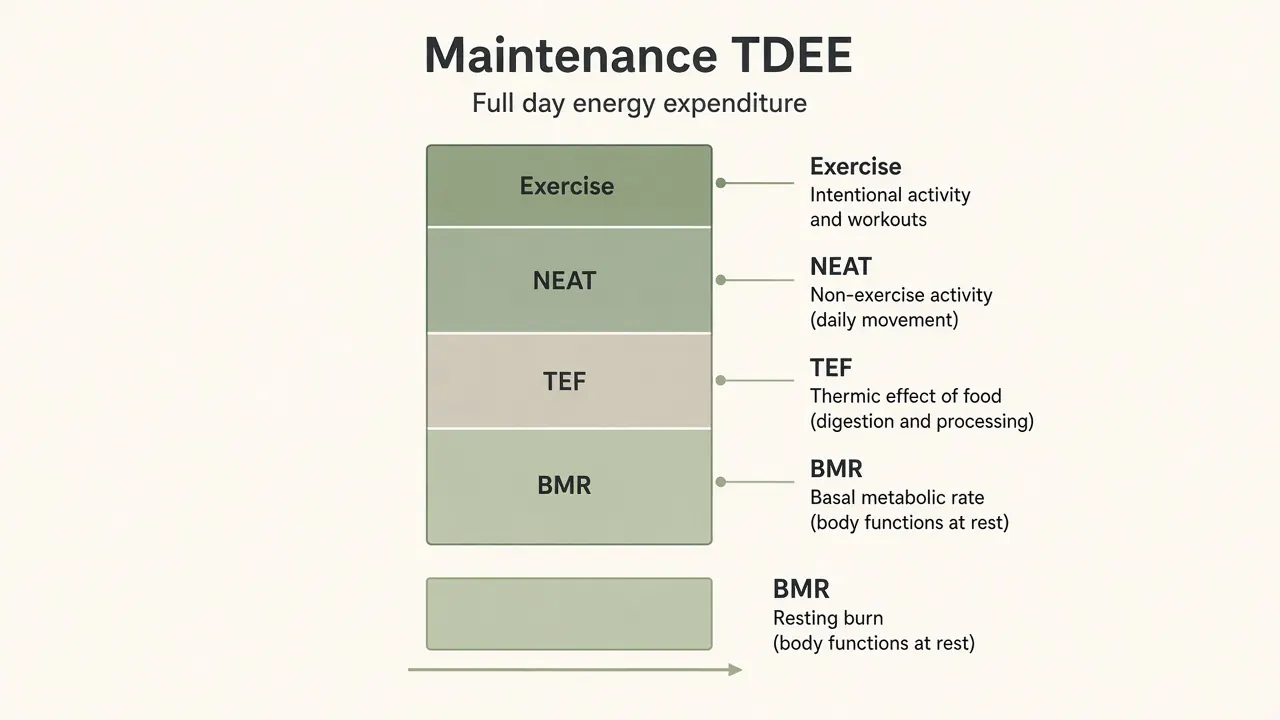
- 2Maintenance calories (TDEE) = BMR + movement + exercise + digestion.
- 3Maintenance is usually 20–90% higher than BMR, depending on activity.
- 4Use maintenance, not BMR, to set a daily calorie goal for loss or gain.
- 5Both numbers are estimates — check them against your real weight trend.
- 6Formulas: Mifflin-St Jeor (default) or Katch-McArdle with body fat %.
BMR vs maintenance calories: BMR is the calories your body burns at complete rest. Maintenance calories (TDEE) are what you burn in a full day, including movement and exercise. Maintenance is always higher than BMR.
Knowing both numbers helps you plan weight loss, gain, or hold without guessing. Plain definition of the hold line: maintenance calories meaning.
Estimate BMR and TDEE — use maintenance (not BMR alone) for daily targets.
Calculate BMR and TDEEWhat is BMR?
BMR stands for basal metabolic rate. It is the energy your body needs to keep you alive: breathing, blood circulation, brain function, body temperature, and cell repair.
If you stayed in bed all day and did nothing, you would burn roughly your BMR.
BMR is affected by:
- Body size — a bigger body burns more
- Muscle mass — muscle burns more energy than fat, even at rest
- Age — BMR slowly falls with age, mostly from muscle loss
- Sex — men usually have a higher BMR because they carry more muscle on average
- Genetics and hormones — thyroid issues can raise or lower BMR
What are maintenance calories?
Maintenance calories are the calories you eat to stay at the same weight. They are also called TDEE (total daily energy expenditure). Full plain-English take: maintenance calories meaning. Label nuance: TDEE vs maintenance calories.
TDEE has four parts:
| Part | What it is | Roughly how much of TDEE |
|---|---|---|
| BMR | Energy used at rest | 60 to 70 percent |
| Thermic effect of food | Energy used to digest meals | About 10 percent |
| NEAT | Daily movement: walking, chores, fidgeting | 15 to 30 percent (varies a lot) |
| Exercise | Workouts and sports | 5 to 10 percent for most people |
These shares change from person to person. A construction worker has a large NEAT share. A desk worker has a small one. Activity honesty: activity level chart.
BMR vs maintenance calories: comparison table
| Feature | BMR | Maintenance (TDEE) |
|---|---|---|
| Meaning | Calories burned at rest | Calories burned in a full day |
| Includes activity? | No | Yes |
| Size | Lower | Higher |
| Changes day to day? | Very little | Yes, with your activity |
| Use it to | Understand your baseline | Plan weight loss, gain, or maintenance |
How to calculate BMR
There are three common formulas. Side-by-side tools: Mifflin-St Jeor calculator and Katch-McArdle calculator. Notes: /#formula.
1. Mifflin-St Jeor (metric: kg and cm)
- Men: (10 × weight in kg) + (6.25 × height in cm) − (5 × age) + 5
- Women: (10 × weight in kg) + (6.25 × height in cm) − (5 × age) − 161
2. Mifflin-St Jeor (imperial: lb and inches)
- Men: (4.536 × weight in lb) + (15.88 × height in inches) − (5 × age) + 5
- Women: (4.536 × weight in lb) + (15.88 × height in inches) − (5 × age) − 161
3. Katch-McArdle (needs body fat %)
BMR = 370 + (21.6 × lean body mass in kg)
To convert pounds to kg, multiply by 0.4536.
Mifflin-St Jeor is the most common choice when body fat is unknown. Katch-McArdle is useful if you know lean mass (for example a lifter with a body scan).
Worked examples
Example 1: Man, 30 years, 80 kg (176 lb), 178 cm (70 in)
(10 × 80) + (6.25 × 178) − (5 × 30) + 5 = 800 + 1,112.5 − 150 + 5 BMR ≈ 1,768 kcal/day.
Example 2: Woman, 30 years, 65 kg (143 lb), 165 cm (65 in)
(10 × 65) + (6.25 × 165) − (5 × 30) − 161 = 650 + 1,031.25 − 150 − 161 BMR ≈ 1,370 kcal/day.
Example 3: Katch-McArdle, lean mass 60 kg (132 lb)
370 + (21.6 × 60) = 370 + 1,296 BMR ≈ 1,666 kcal/day.
If you do not want to do the math, use our free TDEE calculator — it shows both BMR and TDEE.
How to turn BMR into maintenance calories
Multiply your BMR by an activity factor. The activity level chart explains each level.
| Activity level | Multiplier |
|---|---|
| Sedentary (desk job, little exercise) | 1.2 |
| Light (exercise 1 to 3 days per week) | 1.375 |
| Moderate (exercise 3 to 5 days per week) | 1.55 |
| Very active (exercise 6 to 7 days per week) | 1.725 |
| Extra active (physical job plus training) | 1.9 |
Using the examples above at a moderate level (1.55):
- Man: 1,768 × 1.55 ≈ 2,740 maintenance calories
- Woman: 1,370 × 1.55 ≈ 2,124 maintenance calories
At sedentary (1.2), the same man would have about 2,121 calories. Same BMR, very different maintenance — that gap is activity, not resting metabolism.
Do not double-count watch burns on top of the multiplier: does TDEE include exercise?.
Step-by-step: how to figure out your maintenance calories. Hold-weight tool: maintenance TDEE.
Which number should you use?
- To lose weight: eat below maintenance. A 500-calorie daily deficit is roughly 1 lb (0.45 kg) per week — weight-loss TDEE.
- To maintain: eat at maintenance.
- To gain: eat above maintenance — how many calories over maintenance to gain a pound.
Many people make the mistake of using BMR as their calorie goal. BMR does not include any activity, so it is too low as a daily target for most people.
Should you ever eat below your BMR?
As a general rule, eating below your BMR for a long time is not recommended. It can make it hard to get enough protein, vitamins, and minerals, and it can cost you muscle, energy, and sleep quality.
If you need a larger deficit for medical reasons, do it only under the care of a doctor or registered dietitian.
What can change your BMR and maintenance?
- Gaining muscle — raises both numbers slightly
- Losing weight — lowers both, because a smaller body burns less
- Aging — BMR falls slowly; strength training matters more as you get older
- Long, hard dieting — the body can lower energy use a little, which slows fat loss
- Daily movement — a higher step count can raise TDEE by hundreds of calories without gym time
Recalculate every 4–6 weeks, or after you gain or lose about 10 lb (4.5 kg).
Common myths
- Myth: You should eat your BMR to lose weight. Fact: Start from maintenance and subtract a modest deficit.
- Myth: A “fast metabolism” means a high BMR. Fact: People differ by only a few hundred calories once body size and muscle are accounted for.
- Myth: The formulas are exact. Fact: They are estimates — confirm with weekly averages (how to figure out maintenance).
How to check your numbers in real life
- 1Calculate maintenance with the TDEE calculator.
- 2Eat that amount for 2–3 weeks.
- 3Weigh on the same scale, at the same time of day; use weekly averages.
- 4If weight rises, lower calories by 100–200. If it falls, raise them by 100–200.
- 5When your weekly average is flat, you have found your true maintenance.
If paper says you are already below maintenance and nothing moves, audit logging: eating below maintenance not losing weight.
Final thoughts
The difference in BMR vs maintenance calories is simple: BMR is energy for staying alive at rest; maintenance is energy for your whole day. Use BMR to understand your baseline and maintenance to set your calorie target.
Estimate BMR and TDEE — use maintenance (not BMR alone) for daily targets.
Get BMR and TDEE freeRelated reading
Frequently asked questions
No. BMR is calories at rest. Maintenance includes all daily activity, so it is always higher.
TDEE cluster

Written by
TDEEHQ Editorial
Nutrition & metabolism writersBSc Exercise Science · Certified Sports Nutrition Coach
TDEE, BMR, NEAT, maintenance calories, and honest activity multipliers
Riley leads TDEEHQ’s guides on total daily energy expenditure — translating Mifflin-St Jeor, activity multipliers, and NEAT research into decision tools people can actually use. Focus: picking the right activity level, avoiding double-counted exercise calories, and verifying estimates with weekly weight averages.
Expertise
- TDEE & maintenance calories
- Activity level multipliers
- BMR formulas (Mifflin-St Jeor, Katch-McArdle)
- NEAT & everyday movement
- Deficit sizing from TDEE
- Exercise calorie double-counting