Key takeaways
- 1A TDEE calculator gives an estimate, not a measurement.
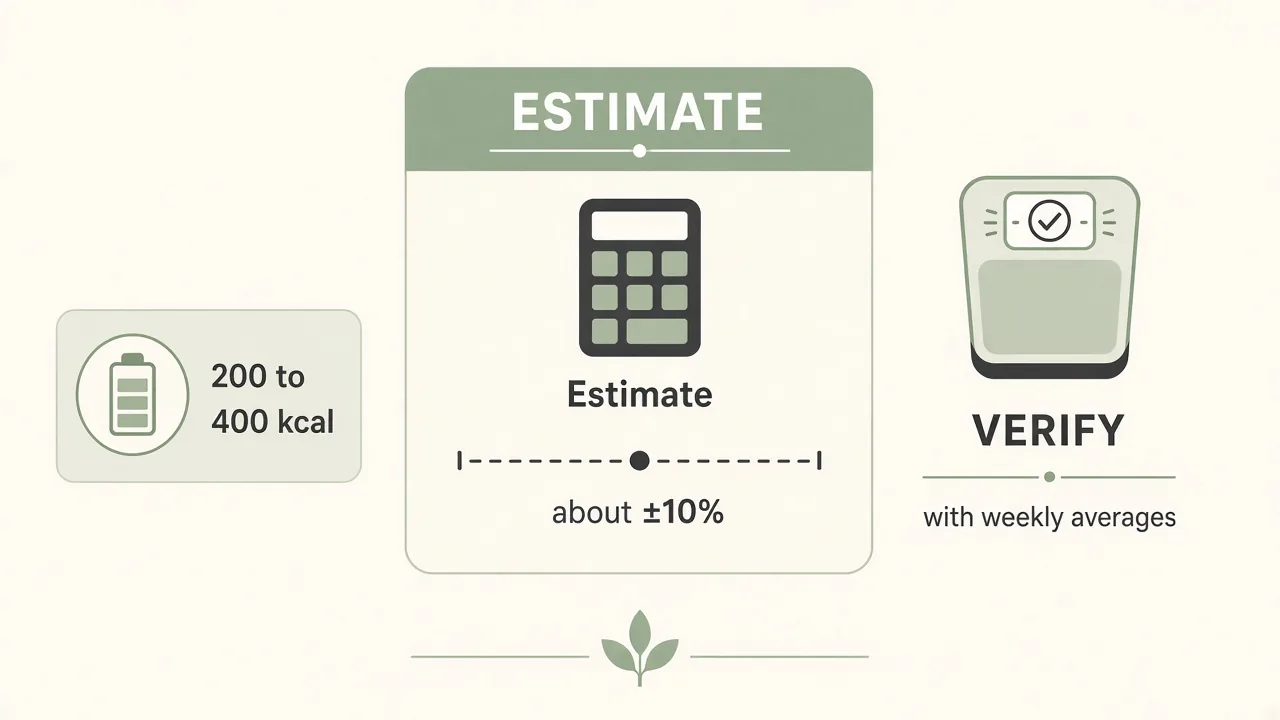
- 2The error is often 10 percent or more, or about 200 to 400 calories per day for many adults.
- 3The biggest source of error is the activity level you pick.
- 4Pick the lower activity level if you are unsure.
- 5Eat your estimate for 2 to 3 weeks, track your weight, and adjust by 100 to 200 calories.
Best answer: Is a TDEE calculator accurate? A TDEE calculator is a good starting estimate, not an exact number. Real results can differ by 10 percent or more, which may be 200 to 400 calories per day.
The good news is that you can fix the error with a few weeks of simple tracking.
Get a starting TDEE estimate — then verify with 2–3 weeks of weekly weight averages.
Calculate your TDEEWhat does a TDEE calculator do?
A TDEE calculator estimates the calories you burn in a day. It uses your age, sex, height, weight, and activity level. If you are new to the term, read maintenance calories meaning (TDEE is the usual label for that full-day estimate).
Most calculators work in two steps:
- 1Estimate your BMR (the calories you burn at rest) with a formula.
- 2Multiply BMR by an activity factor to estimate your total daily burn.
See how this works in BMR vs maintenance calories. You can try the steps yourself with our free TDEE calculator.
Which formulas do calculators use?
| Formula | Needs | Best for |
|---|---|---|
| Mifflin-St Jeor | Age, sex, height, weight | Most adults |
| Katch-McArdle | Body fat percentage | Lean or muscular people who know their body fat |
| Harris-Benedict | Age, sex, height, weight | Older formula, often runs a bit high |
Side-by-side tools: Mifflin-St Jeor calculator and Katch-McArdle calculator. Notes on how we estimate: /#formula.
Is a TDEE calculator accurate for most people?
For a typical adult, the answer is: close enough to start, but not close enough to trust blindly.
In validation studies, Mifflin-St Jeor predicts resting metabolic rate within about 10 percent for a majority of adults, but a real minority fall outside that range.
Individual results can still be off by a few hundred calories per day.
Accuracy is lower for very lean, very muscular, and very overweight people.
Here is what a 10 percent error looks like:
| Calculator says | 10% lower | 10% higher |
|---|---|---|
| 1,800 kcal | 1,620 kcal | 1,980 kcal |
| 2,200 kcal | 1,980 kcal | 2,420 kcal |
| 2,400 kcal | 2,160 kcal | 2,640 kcal |
| 3,000 kcal | 2,700 kcal | 3,300 kcal |
A 240-calorie error is about 0.5 lb (0.23 kg) per week of weight change. That is small day to day, but it adds up over a month.
Why TDEE calculators miss
There are five main reasons the number can be wrong.
1. Your activity level is a guess
The activity multiplier is the biggest weak spot. Most people overestimate how active they are. A person who trains 4 times per week but sits for 9 hours a day is not truly in the very active group. Check the activity level chart before you choose. Also avoid double-counting watch calories: does TDEE include exercise?.
2. Metabolism differs between people
Two people of the same age, weight, and height can burn a few hundred calories differently. Genetics and hormones play a role.
3. The formula does not know your body composition
Muscle burns more than fat. Mifflin-St Jeor only sees your weight, so it can underestimate a muscular person and overestimate a person with high body fat.
4. Daily movement (NEAT) varies a lot
Steps, fidgeting, standing, and chores can change your burn by hundreds of calories. A calculator cannot see how much you really move.
5. Food tracking errors make it look worse
People often log fewer calories than they eat. Restaurant meals, oils, sauces, and weekends are the usual gaps. When the calculator seems wrong, the food log is sometimes the problem. Flat scale in a supposed deficit: eating below maintenance but not losing weight.
Quick accuracy guide
| Situation | Likely accuracy |
|---|---|
| Average adult, honest activity level | Fairly close |
| Very active or athletic | Often underestimates |
| Overestimated activity level | Often overestimates |
| Very lean or very high body fat | Less reliable |
| Pregnancy, illness, or medical conditions | Not reliable — ask a doctor |
What about fitness watches and apps?
Fitness trackers also estimate calories burned. Studies of wrist devices have found large errors in energy expenditure, often much larger than the error in heart rate or steps.
Use a watch for trends, such as steps and sleep. Do not treat its calorie number as exact. A calculator plus your own weight trend is more useful. Method detail: does TDEE include exercise?.
How to find your real maintenance calories
This is the best fix. It takes 2 to 3 weeks and uses your real body as the test. Step-by-step: how to figure out maintenance calories.
- 1Use the TDEE calculator for your starting number.
- 2Eat that amount for 2 to 3 weeks. Log your food as honestly as you can.
- 3Weigh yourself every morning, after the toilet and before eating.
- 4Take the weekly average weight. Compare week 1 with week 2 and week 3.
- 5If your average weight rises, lower calories by 100 to 200. If it falls, raise them by 100 to 200.
- 6When your weekly average stays flat, that calorie level is your true maintenance.
Example: testing a calculator number
Say a calculator gives you 2,400 calories. You eat 2,400 calories for three weeks and lose about 1 lb (0.45 kg) per week.
1 lb per week is about 3,500 calories per week, or 500 calories per day.
So your real maintenance is about 2,400 + 500 = 2,900 calories.
The calculator was about 500 calories too low, an error of roughly 17 percent.
The opposite can happen too. If you gain 1 lb (0.45 kg) per week at 2,400 calories, your real maintenance is closer to 1,900.
This same method is how you set a surplus. See calories over maintenance to gain a pound.
How to make your TDEE estimate more accurate
- Choose the lower activity level when you are between two choices.
- Use Katch-McArdle if you know your body fat from a reliable scan.
- Track steps. An average of 8,000 to 10,000 steps usually means light to moderate activity, not very active — see walking 10k TDEE.
- Weigh daily and use the weekly average. One reading is mostly water noise.
- Wait two weeks before changing calories. Short changes can mislead you.
- Recalculate every 4 to 6 weeks, or after you gain or lose about 10 lb (4.5 kg).
Common mistakes
- Picking the very active level because you work out 3 times a week.
- Changing your calories after only 3 or 4 days.
- Trusting a watch’s calorie burn more than your scale trend.
- Forgetting weekends, drinks, oils, and snacks in the food log.
- Using a calculator when pregnant or ill, without asking a doctor.
When a calculator is not enough
Talk to a doctor or registered dietitian if:
- You are pregnant or breastfeeding.
- You have a thyroid condition, diabetes, or another medical issue.
- You take medication that affects appetite or weight.
- You have a history of disordered eating.
- Your weight changes quickly with no clear reason.
In these cases, a generic estimate can be misleading.
Final thoughts
So, is a TDEE calculator accurate? It is accurate enough to start, and it becomes accurate for you once you test it against your own weight trend. Treat the first number as a hypothesis, not a fact.
Ready to get your starting point? Try our free TDEE calculator, then follow the 2–3 week test above.
Related reading
Frequently asked questions
It is accurate enough to start. Eat the estimate for 2 to 3 weeks, then adjust using your real weight trend.
TDEE cluster

Written by
TDEEHQ Editorial
Nutrition & metabolism writersBSc Exercise Science · Certified Sports Nutrition Coach
TDEE, BMR, NEAT, maintenance calories, and honest activity multipliers
Riley leads TDEEHQ’s guides on total daily energy expenditure — translating Mifflin-St Jeor, activity multipliers, and NEAT research into decision tools people can actually use. Focus: picking the right activity level, avoiding double-counted exercise calories, and verifying estimates with weekly weight averages.
Expertise
- TDEE & maintenance calories
- Activity level multipliers
- BMR formulas (Mifflin-St Jeor, Katch-McArdle)
- NEAT & everyday movement
- Deficit sizing from TDEE
- Exercise calorie double-counting